







RTX Spark: Can Nvidia Replicate the Success of Apple Silicon?
Nvidia Enters the Arm Laptop Processor Market with RTX Spark
RTX Spark: Can Nvidia Replicate the Success of Apple Silicon?
June 2, 2026

RTX Spark: Can Nvidia Replicate the Success of Apple Silicon?
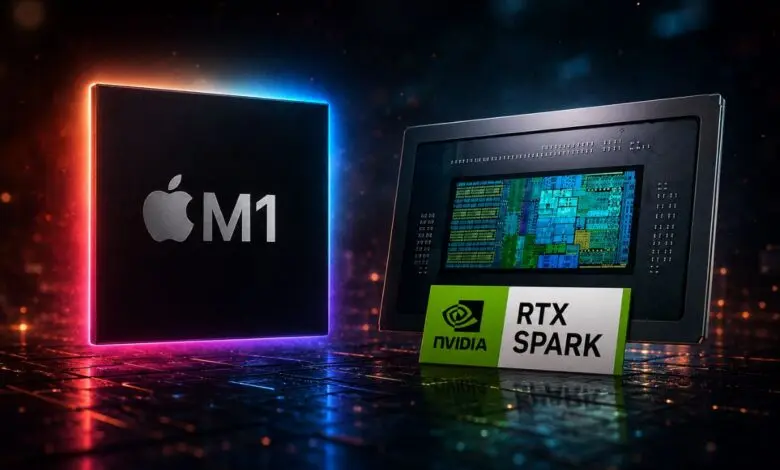
Nvidia is preparing to trigger one of the most significant shifts in the laptop market since the emergence of Apple Silicon. The company has officially unveiled its new "RTX Spark" chips, designed for Windows-based laptops—a move that could reshape the competitive landscape among processor and computer manufacturers in the coming years.
This announcement comes at a time when the personal computing sector is witnessing an accelerating race toward processors built on the Arm architecture—a standard that Apple successfully redefined for performance and energy efficiency with its M-series chips, used in MacBook devices. Since the launch of the M1 chip in 2020, Apple has established a new reality in the laptop market by combining high performance, long battery life, and quiet, efficient cooling—compelling Windows-focused companies to seek alternatives capable of matching that experience.
Even with the entry of companies like Qualcomm—via the Snapdragon X Elite processor series—Arm-based Windows devices have yet to achieve the seamless, end-to-end integration found in Apple’s Mac ecosystem, particularly in areas such as graphics, gaming, and professional-grade applications. It is precisely here that Nvidia aims to leverage its extensive expertise in graphics processing and artificial intelligence to deliver a platform that stands apart from the competition. High-End Specifications Targeting Professionals
Nvidia describes the RTX Spark platform as "the most efficient chip ever created for personal computers," featuring a design that integrates traditional processing power with advanced graphics capabilities into a single, unified chip. It includes 20 CPU cores, 6,144 CUDA cores for graphics, and up to 128GB of unified LPDDR5X memory—specifications that firmly position it within the category of high-performance professional computing.
According to the company, the integrated GPU delivers performance comparable to an RTX 5070 Laptop GPU—a remarkable feat for the laptop market, where slim devices have historically relied on less powerful graphics processors to manage power consumption and battery life.
Nvidia has yet to release actual benchmark results or direct comparisons against the MacBook Pro or other competing systems, leaving many questions regarding its real-world performance under heavy, intensive workloads.
The RTX Spark is based on the GB10 chip—the same silicon used in the DGX Spark, a compact system designed for artificial intelligence. This indicates that the project is not merely aimed at conventional computing; rather, it is primarily focused on generative AI applications and running models locally, eliminating the need for a constant connection to cloud servers. During the conference where the new chip was unveiled, CEO Jensen Huang placed significant emphasis on the concept of "AI Agents," describing them as the next primary growth driver for the company. He explained that future computers will not merely be traditional operating tools, but rather platforms capable of executing complex tasks locally, powered by advanced AI models running directly on the device.
Nvidia’s target audience extends beyond AI developers to include content creators, photographers, and video editors. Adobe has announced official support for the new chip through optimized versions of Photoshop and Premiere Pro—a clear move to challenge the MacBook Pro, which has long dominated the design and creative production market.
Computers equipped with the new "RTX Spark" chips are expected to reach the market in the fall of 2026, offered by a wide range of manufacturers, including Microsoft, Dell, HP, Lenovo, Asus, and MSI, as well as Acer and Gigabyte.
Devices already announced with the new chip include Microsoft’s new "Surface Laptop Ultra," along with models such as the Dell XPS 16, Lenovo Yoga Pro 9n, and Asus ProArt P16—all of which are high-end, professional-grade machines. High Prices That Could Exceed $4,000
It appears that Nvidia does not plan to offer budget-friendly devices in the initial phase. Estimates suggest that prices for the new computers could start at around $2,500, with some versions—equipped with 128GB of RAM—potentially exceeding the $4,000 mark. While these price points are significantly higher than those of most conventional Windows PCs, they align with the cost of the components used, particularly the massive unified memory and advanced graphics processors.
Analysts point out that Nvidia’s strategy differs radically from Apple’s approach when it launched its first "Apple Silicon" chip, the M1. At that time, Apple began with relatively affordable devices, such as the MacBook Air and Mac Mini, which allowed the new technology to reach a broad range of users and developers very quickly. Nvidia, by contrast, seems to be skipping the "M1-style" introductory phase entirely, moving straight to competing with the M1 Max and M1 Ultra chips designed for professionals.
On the other hand, this move could provide a major boost to the Windows-on-Arm ecosystem—particularly in the gaming sector, which has remained a key weakness for Arm-based processors over the past few years. Currently, Nvidia and Microsoft are working with game developers and security software providers to port anti-cheat technologies to the Arm architecture. This development marks a significant step toward improving game compatibility with Arm-based architecture—a long-standing issue that has previously hindered the adoption of such devices among gamers and professional users. If Nvidia succeeds in delivering robust graphical performance, long battery life, and enhanced game compatibility, its "RTX Spark" devices could emerge as the first genuine competitor to the MacBook Pro in the high-end laptop market.
A Four-Way Global Rivalry